How to Build a Trading Confluence Stack That Actually Filters Entries
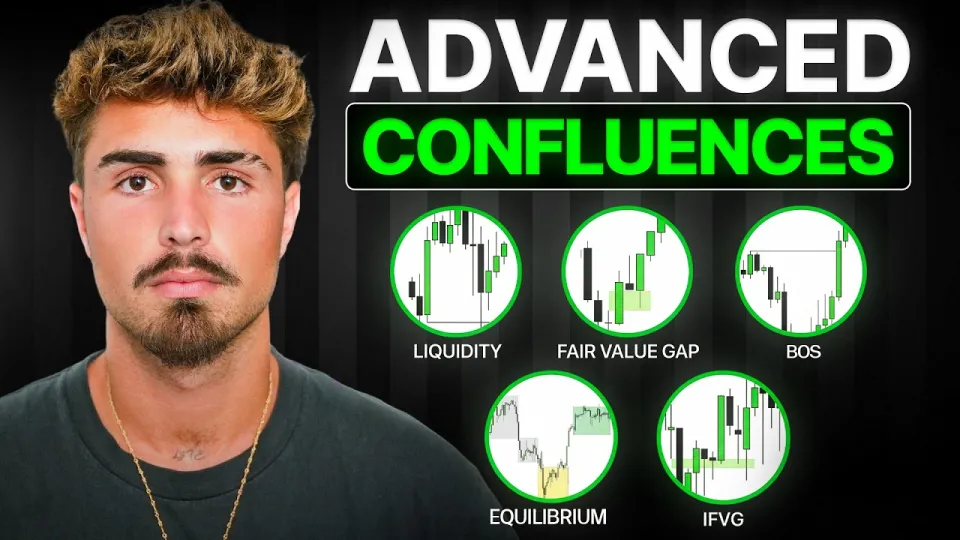
Video: Learn Every Trading Confluence In 18 Minutes
You can order the same kind of articles for your own video to boost it on YouTube and Google. Just message the Telegram bot @sat_sit_bot. The bot writes and publishes the articles itself (with your YouTube video embedded) on popular topical websites (no ads). Your first 50 articles are free.
· based on the channel TJR
Key takeaways
- A confluence is two or more independent signals pointing to the same price zone, not the same idea drawn twice on one chart.
- The five confluences covered in TJR's 18-minute breakdown are liquidity, fair value gap, inverse fair value gap, equal highs/lows and break of structure.
- More confluences is not automatically better: each added factor raises selectivity but also cuts the number of trades available.
- Liquidity sweeps and fair value gaps work best when they line up with a higher-timeframe level rather than a random intraday candle.
- A written rule set with fixed invalidation is what turns a stack of confluences into a repeatable trading process.
Trading with confluence means stacking two or more independent signals that point to the same price zone before you take a position, and the practical way to do it is to pick a small set of repeatable concepts, require them to align on the same level, and define in advance what invalidates the setup. TJR's breakdown "Learn Every Trading Confluence In 18 Minutes" walks through the core building blocks — liquidity, fair value gaps, inversions, equal highs and break of structure — and the full framework behind that approach is laid out in the trading blueprint.
What a trading confluence actually is and why stacking matters
A confluence is confirmation from a second, independent source, not a second drawing of the same idea. If you mark a support level and then circle the same candle twice, you have one signal and a false sense of conviction; if a liquidity sweep, an imbalance and a higher-timeframe level all sit within the same few ticks, you have three reasons for the market to react there.
The logic is statistical rather than mystical. Each individual concept fires often and produces plenty of noise, but the overlap of unrelated concepts is rarer, so the sample you actually trade shrinks and the average quality of that sample rises. The trade-off is real: every condition you add removes setups, and a stack that is too strict can leave you with one entry per week on a five-minute chart. The right number of confluences is the number that keeps you in enough trades to test your edge while cutting the ones you would not want to explain to another trader.
The five confluences TJR groups in one walkthrough
The video's structure is essentially a checklist, and each item answers a different question about the chart. Liquidity asks where resting orders sit and where price is likely to be pulled; a fair value gap asks where price moved too fast to trade efficiently; an inverse fair value gap asks whether a previous imbalance has flipped from support to resistance or the reverse; equal highs and lows ask where obvious stops are clustered; break of structure asks whether the market has actually changed direction.
- Liquidity — prior highs and lows, session extremes and obvious swing points where stop orders accumulate. Price often reaches into these pools before reversing.
- Fair value gap — a three-candle imbalance where the wicks of the first and third candle do not overlap, leaving an untraded zone that price frequently revisits.
- Inverse fair value gap — a gap that was traded through and now acts as the opposite type of zone, a sign that the imbalance has been repurposed rather than erased.
- Equal highs and equal lows — two or more highs or lows at nearly the same price, which read as engineered liquidity rather than genuine rejection.
- Break of structure — a close beyond a meaningful swing point that confirms the sequence of higher highs or lower lows has been interrupted.
None of these is a signal on its own. A fair value gap in the middle of a range with no liquidity nearby is just a gap; a break of structure with no imbalance to enter from leaves you chasing.
How to combine liquidity and fair value gaps without over-filtering
Liquidity and fair value gaps pair naturally because one describes the destination and the other describes the entry. The common sequence is a sweep of a prior high or low that leaves an imbalance behind, followed by a return into that imbalance and a continuation away from the swept level.
A workable rule set looks like this:
- Mark the prior session high and low, the previous day's high and low, and the nearest swing points on your higher timeframe.
- Wait for price to trade into one of those levels and sweep it, rather than stopping just short.
- Identify whether the displacement leg left a fair value gap. If it did not, the sweep alone is a weaker signal.
- Use the edge of the gap, not its midpoint, as the entry zone, and place invalidation beyond the sweep extreme.
- Skip the setup if the gap sits directly against a higher-timeframe level that has not been tested.
That last filter matters more than most traders expect. A gap that forms into resistance on the daily chart is a gap you are trading against the larger flow, and no amount of lower-timeframe confluence fixes that.
Where inverse fair value gaps and equal highs change the read
An inverse fair value gap is the concept that tells you a zone has changed jobs. When price closes through a fair value gap and then returns to it from the other side, the zone that previously supported price can start acting as resistance, and vice versa. Treating it as a fresh area rather than a broken one is what separates a useful read from a stale chart marking.
Equal highs and equal lows are the other concept that changes interpretation rather than adding a new one. Two touches at almost exactly the same price look like strong resistance, but they usually represent a cluster of stops sitting just above or below. That makes them a liquidity target: the market has a reason to push through the level, take the orders and then decide what to do next. A sweep of equal highs followed by a break of structure in the opposite direction is one of the cleanest confluence patterns available, because the fuel and the confirmation arrive in the same move.
Building your own confluence checklist in practice
A checklist only helps if it is short enough to run in real time. Take the five concepts above and rank them by how much they change your decision, then require the top two and treat the rest as tie-breakers.
- Define your higher-timeframe bias first — which side of the market you are willing to trade at all.
- Mark liquidity levels before the session opens, not after price has already reacted to them.
- Wait for the sweep, then look for the imbalance left behind by the displacement.
- Confirm with a break of structure on your entry timeframe; if structure is intact against you, pass.
- Write down the invalidation price before entering and size the position from that distance.
- Log every setup you skipped and why, so you can tell later whether your filters helped or just kept you out.
That log is the part most traders skip, and it is the only way to know whether a confluence stack is genuinely improving your results or simply making you feel more certain. A stack of five conditions that produces a 30% win rate with poor average risk-reward is worse than a single condition that produces consistent, explainable trades.
Common questions traders raise about confluence systems
Viewers of the breakdown tend to raise the same doubts, and they are worth answering directly. The first is whether more confluences mean better trades. They do not, automatically — each addition raises selectivity and lowers frequency, and past a certain point you are curve-fitting to your own recent losses rather than filtering noise.
The second is whether these concepts work across markets. Liquidity, imbalances and structure are descriptions of order flow, so they apply to futures, forex and crypto alike, but the practical details differ: crypto trades around the clock, so session-based liquidity levels need rethinking, while index futures have clear session boundaries that make prior highs and lows more meaningful.
The third is the expectation problem. Screenshots of large gains circulate constantly, and the honest framing is the one the channel itself puts in its disclaimers: day trading is risky and most day traders lose money. Treat any confluence stack as a decision framework to be tested on small size, not as a promise of returns. The fourth is discipline — traders consistently say the hard part is not learning five concepts but showing up and following the same rules when a setup fails three times in a row.
Useful links
- Trading blueprint — the full system for becoming a consistently profitable trader
- Indicators TJR uses daily
- Funded account raffle entry
- Alpha Futures funded accounts — 10% off
- Lucid Trading — 40% off
Final takeaway
A confluence stack is a filter, not a signal generator: liquidity tells you where the market is drawn, fair value gaps tell you where the entry is, inversions tell you the zone has changed roles, equal highs flag where stops are parked, and break of structure tells you the direction has actually shifted. Pick two or three of those, demand they line up on the same level, and write down the invalidation before you click. TJR's 18-minute walkthrough is a compact map of the concepts, and the blueprint is where the channel takes the process further. Test on small size, keep a log, and let the record — not the feeling of certainty — tell you whether your stack works.
Questions & answers
How many confluences should a single trade have?
Two or three independent confirmations are usually enough: for example a liquidity sweep, a fair value gap to enter from, and a break of structure in the direction you want to trade. Adding more conditions cuts the number of setups sharply, so test whether each extra filter actually improves your results before keeping it.
Do fair value gaps and liquidity concepts work in crypto as well as futures?
Yes, because both describe how orders are placed and filled rather than a specific instrument. The practical difference is session structure: index futures have clear opens and closes that make prior highs and lows meaningful, while crypto trades continuously, so you need to define your own reference windows instead of relying on a session boundary.
What is an inverse fair value gap in simple terms?
It is a fair value gap that price has already traded through and closed beyond, so the zone flips role — former support becomes resistance or the reverse. Traders watch it because a return to that flipped zone can offer an entry in the new direction rather than a continuation of the old one.
Is a big confluence checklist enough to become profitable?
No. A checklist only standardises decisions; profitability depends on risk management, position sizing and the discipline to follow the same rules when several setups fail in a row. Most traders who struggle are not short of concepts but short of consistency, which is why logging skipped and taken trades matters as much as the entry rules.
Source: Learn Every Trading Confluence In 18 Minutes · Markdown version